Friday, 15 March 2019

Letters from Cuba, June 2009 (6) Trinidad de Cuba


Trinidad de Cuba, Hostel Vivien y Pablo, June 2009

There are thunderstorms in Trinidad de Cuba each afternoon, and this clears the air. Our casa particulara is Hostel Vivien y Pablo in Media Luna which is just above the main square, and is near to Trinidad’s biggest craft market; it is also near the Casa de la Trova and other music spots. The house has large tiled reception rooms, and our bedroom opens onto a beautifully restored Spanish-style courtyard. This house has been passed down through Vivien’s family. It is quite grand, and I think the family has done well through its links with the Paradiso tour company.

Bill Barrie relaxing at Hostel Vivien y Pablo, Trinidad de Cuba, July 2009

Business card for Hostel Vivien y Pablo, Trinidad de Cuba, 2009. Photo: Ann Barrie

Our breakfasts are the same as at other casa particulares: fruit juice, fruit, coffee, and eggs the way you want them. 

Bill Barrie feeding the cat at breakfast. Hostel Vivien y Pablo, Trinidad de Cuba, 2009

Our fellow guest at Hostel Vivien y Pablo is Denis, a jovial Australian, aged 60, who had a stroke three years ago and now spends his life travelling on full salary. 


Chicken dinner, Hostel Vivien y Pablo, Trinidad de Cuba, 2009  Photo: Ann Barrie

Bill and I have eaten only one dinner here – a chicken meal. 
Pablo, the proprietor, told us that his brother is a fisherman and would catch fresh lobster for us – but we decided against a lobster meal after Bill saw the freezer crammed full of lobster tails. Classically-trained chef that he is, Bill nearly wept when he saw the hard-working maid preparing Denis's lobster meal – she simply placed the frozen tails on a hot grill and drenched them with salt.

Trinidad de Cuba was founded by Spanish explorer Diego Velzuez in 1514. With its red-tiled roofs, pastel-coloured buildings, and shaded courtyards, it is the main tourist spot outside Havana, and is a UNESCO world heritage site. We were initially rather disoriented and disappointed, but, as is often the case, once we began scratching beneath the surface, the town became increasingly interesting.

There is live music everywhere in Trinidad. We went to the Casa de la Musica, which is in the open air, halfway up the steps by the cathedral. Slim-hipped young Cuban men were dancing with tourists (Denis said the men are gigolos). We have been to the Casa de la Trova twice, and we heard two different 7-8 piece bands, always with double bass, guitar, maracas, and often a trumpet, too. We also listened to a group playing African music in a leafy outdoor bar. Groups often compose their own music, and they request you to buy their CD, or otherwise to leave a small donation. 
Musicians at Casa de la Trova, Trinidad de Cuba. Photo: Ann Barrie, 2009

One morning, Bill and I followed the rhythmic sound of drums – it led us to a school of dance where black Cuban children were rehearsing for a festival:


Children at a school of dance, Trinidad de Cuba, 2009. Photo: Ann Barrie

On the way home, I stopped with Denis to listen to a group of men playing on the roadside opposite our accomodation. The men didn’t care whether they had an audience or not  they simply wanted to make music: 

Street musicians, Trinidad de Cuba. Photo: Ann Barrie, July 2009

There is a lot of art for sale in this town. For instance, on the Plaza Mayor there is an attractive balconied building containing the Galeria de Arte Universel. 

Art in gallery in Trinidad de Cuba. Photo: Ann Barrie, 2009

We visited two museums: Museo Historico Municipal, and also Museo Romantico. The latter is housed in a mansion and filled with French, Spanish, German period pieces collected from other Trinidad mansions. There were many attendants, sitting there doing crochet and other handiwork, and I bought a piece from my guide.

Plaza Major, Trinidad’s beautiful central square, has a security presence to stop locals pestering tourists for money. It also has two fine bronze hounds.

Plaza Major with bronze statues of hound, Trinidad de Cuba, 2009. Photo: Ann Barrie
*
2019 note: Australian Denis departed Trinidad on the same coach as Bill and me – he is on the left of the following photo, and Bill is on the right. It is poignant to look at this photo and observe my doughty Scottish husband, 16 years my senior, wearing a knee support brace. Nowadays, I need to consider such products for myself – Bill and I would have chuckled about that.


Australian, Denis (L), and New Zealander Bill Barrie (R) heading for Viazul coach, Trinidad de Cuba, 2009

Blog by Ann Barrie

Wednesday, 6 March 2019

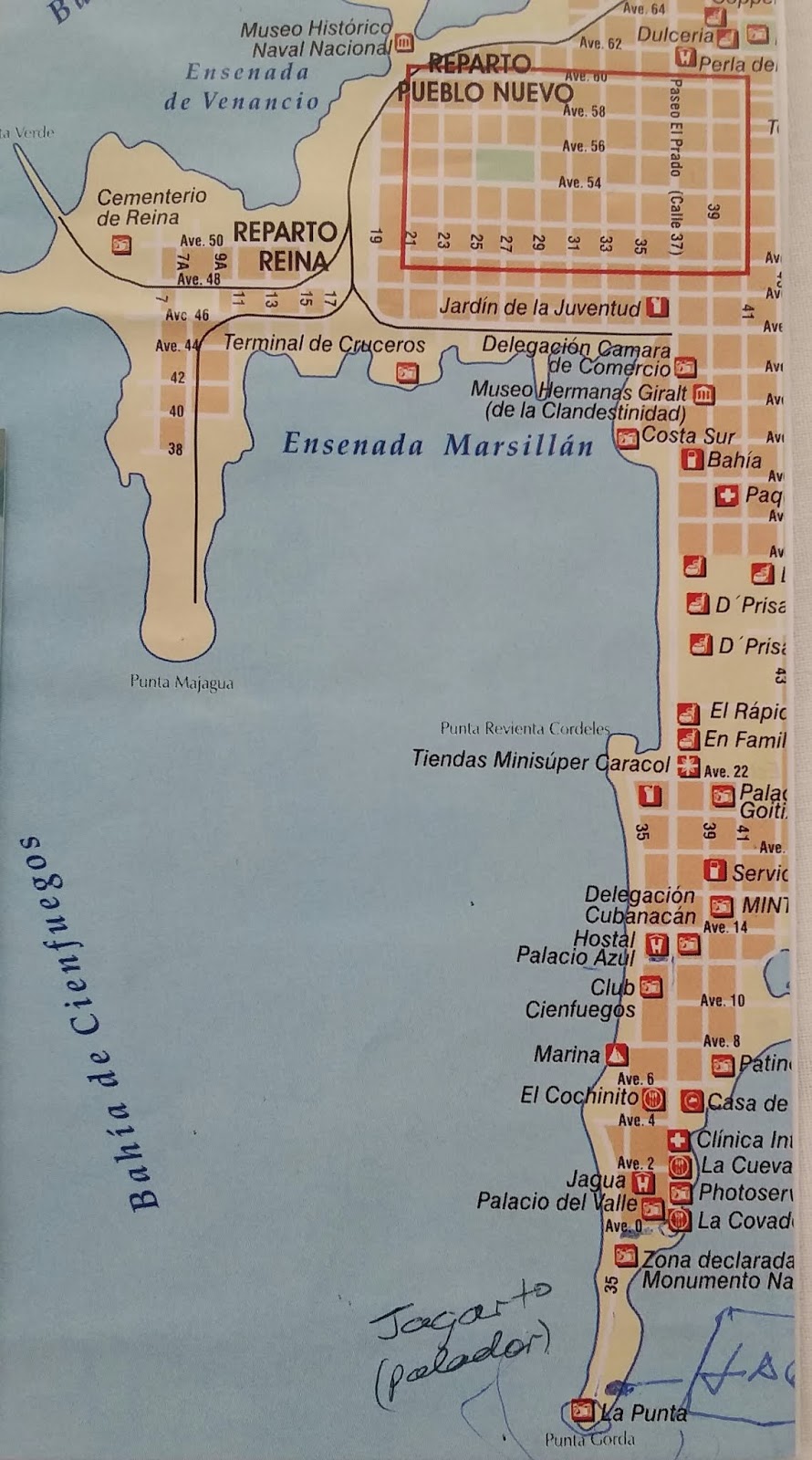
Letters from Cuba, June 2009 (5) Cienfuegos guide

Greetings from Cienfuegos, June 2009


Cienfuegos town plan    Photo: Ann Barrie
The smiling Miriam, who mixed our cocktails on our arrival at Palazio Azul, works long hours. She was on duty until after 10.30 pm, and then again from 7.00 am serving and cooking breakfasts.

We had the morning at leisure, and so we walked toward the centre of town, hugging the water and the shade trees. We saw numerous casas particulares and guesthouses, which is understandable, as this peninsula is an attractive place to stay. We also saw lots of men, often in uniform, training dogs, probably to become guard dogs; these dogs looked healthy and well fed, but most dogs in Cuba are very thin. By about 10.30 am, the heat was getting the better of us, and so we hired a horse and cart to take us back to our hotel. (Horses and carts also serve as buses, with scheduled stops, on this peninsula.)


Ann Barrie on Cienfuegos 'bus' July 2009

We were collected at noon by our taxi driver, and our guide, Ivien. He took us for a drink on the rooftop terrace of Palacio de Ville, and then lunch at the Cienfuegos Club. At last someone with whom we could converse in English! He said, ‘Ask me anything you like’, and so we did. Ivien is thirty. His paternal grandfather came from Andalusia, Spain, and married a black Cuban woman. On his mother’s side he is Chinese, Indian, English and more.
Ivien choses the technology-computer stream at high school and now works as a software engineer for Artex, a Cuban Government enterprise that provides souvenirs, postcards etc, and has links with travel agencies. Apparently, Latin American Travel, which organised our five-day tour, is an Australian company, but it has to work through the Cuban travel company Paradiso.

Ivien said wages are very low, and soap is a genuine luxury, except for people like owners of casas particulares who are mostly better off than the average. Ivien's tour guiding for Paradiso is in addition to his Artex job, and is partly to improve his English, but also, so he can afford to pay for the room he rents in Trinidad de Cuba. He would normally live in the family home in Santa Clara, but his work has taken him away. Ivien’s father is an engineer in the sugar industry and travels internationally; his mother is a school teacher, trained during the education drive after the revolution.

When I asked Ivien if he was happy living in Cuba, or would prefer to live overseas, he looked wistful and said he had a group of friends living in Miami. They got there illegally via other countries —he said that once a Cuban has a foot on American land, he or she can stay. Another group of his friends live in Canada.

Ivien said that Cubans, if they have the money, can buy and well pre-1959 cars freely. However, to buy or sell more recent cars, you need official permission. If you have worked overseas you might get help to buy a car.
Bill Barrie (R) and guide Ivien, Cienfuegos historic centre, July 2009

After lunch, Ivien took us on a tour of the historical centre of Cienfuegos. I particularly loved the Téatro Tomás Terri, and paid one CUC to look round inside. There were ornate frescos on the ceiling, a sloping stage, and seats carved from Cuban hard woods. Artists who have trod the boards here include Enrico Caruso, Anna Pavlova and Sarah Bernhardt. After our tour, we were driven by taxi to Trinidad de Cuba.

Titbits:
·      There is no mains pressure in Cuba. Water all comes from tanks on roofs etc.
·      Traffic lights are very faint in Havana.
·      All light bulbs seem to be the eco-friendly variety.
·      We’ve seen little in the way of garden cultivation in the bigger towns.
·      Drinks in Cuba include excellent canned and bottled beer (Bucanero is strong, and Cristal is weaker); strong coffee; wonderful fruit purées; and rum, of course.


Blog by Ann Barrie

Friday, 1 March 2019

Letters from Cuba, June 2009 (4) Havana to Cuenfuegos


After we all boarded the Viazul coach that would take us from Havana to Cienfuegos, one of the drivers came round and solemnly us a toffee from a small tray. These long distance coaches are comfortable and air conditioned and are for tourists and others who can pay in CUCs. Astro coaches ply the same routes, plus additional routes, and are for the locals.  Theoretically, each Astro coach has two seats reserved for CUC-paying customers.

The main highway out of Havana was in better condition than we had expected, and traffic was not heavy. Lots of Cubans were standing on the side of the road hitch hiking — the understanding is that cars with spare room will pick them up. 

We were surprised at the lack of land under cultivation near Havana, although we did later pass an orange plantation. There were plenty of thin cows grazing under trees, and we also saw goats. This all changed once we got into Cienfuegos province and onto secondary roads. The route was picturesque with numerous tractors on the roads, plus horses and carts; raised vegetable gardens; flame trees; and rich soil. The town of Rodas caught my fancy — Cuba would be a great country for a cycling holiday so you could get into these smaller towns.

Cienfuegos is more prosperous than most towns in Cuba. It is a beautiful place, known as the Pearl of the South. The city proper was founded in 1819 by Louis d’Clouet, a French émigré from Louisiana, who sponsored a scheme to bring 40 families from Bordeaux, France. In the late 19th Century, a time of prosperity, local merchants pumped money into an array of dazzling buildings in neo classical style.

We stayed in the Palacio Azul on the narrow Gorda peninsula. Gorda was the aristocratic quarter of the city in the early 1900s and has brightly coloured art nouveau villas. Our blue palace was built in 1921 and reopened as a seven-room hotel in 2004. The whole place oozes character. We were greeted by a small line of smiling staff and immediately — even before we had put down our suitcases — offered a pale green frozen Daiquiri cocktail. 


Bill Barrie enjoying a frozen Daiquiri cocktail at Palacio Azul, Cienfuegos, 2009. 
*
Palacio Azul, Cienfuegos. Photo: Ann Barrie, 2009
*
Palacio Azul, Cienfuegos. Photo: Ann Barrie, 2009

Our room  had the expected little touches to make life comfortable: bath, hair drier, shampoos, and even a 240-volt power point so I could charge my phone. 

We climbed up to the striking rooftop cupola for maritime views all round. Later, we went next door for a shrimp dinner at the Club Cienfuegos, another magnificent building with fine views. The German couple at the next table noticed Bill’s New Zealand T-shirt and introduced themselves. They holidayed in New Zealand a few years ago, and are now exploring Cuba with a guide. They, like us, are staying at Palacio Azul, and there are also two French couples.

View of Club Cienfuegos and Gorda Peninsula. Photo: Ann Barrie, 2009

In front of the Club Cienfuegos we noticed young people playing tennis, using balls with very little bounce. We had brought with us in our luggage, 45 top-grade tennis balls, kindly donated by my brother-in-law, as we’d heard they were in short supply here. The young people and their coach were delighted to receive some of these balls.

We walked the short distance to the end of the peninsula to the magnificent Palacio de Ville, a Moorish revival-style building. Next door is the vast, more recent Hotel Jagua, formerly a notorious casino owned by the Batista brothers. I was able to use the Internet there — 6 CUC for one hour. As night fell, and after a thunderstorm, we watched navy skies and dark blue palm trees — very dramatic. 

Blog by Ann Barrie


Friday, 15 February 2019

Letters from Cuba, June 2009 (3) Havana people

Our first full day in Havana was marked by adjusting to the heat, and learning to pace ourselves. We managed a short walk along the quay looking out onto the Castillo del Morro, the giant fortress at the mouth of Havana Harbour. We could see the colossal Cristo de Habana, which is of white marble and can be glimpsed from many parts of Habana Vieja.

We also learned to get used to people softening us up and then making demands. For instance, the black African man who said he played for the Buena Vista Social Club and intended to visit New Zealand —and, one more thing, could we go to the shop across the road for me and buy some Pampers (disposable nappies) for his baby. And the man who asked Bill for a light, which he willingly provided, but, when asked why he didn’t have a lighter, said that a lighter costs the same as a packet of cigarettes, and it’s much better to buy the cigarettes.

Our waitress at the El Alfreizar Arabian restaurant asked if we had any soap (unfortunately, I had left my stock in my suitcase). Then she said she earns only $10 per month and had to support an elderly mother; if we planned to leave a tip, please could we place it under the tablecloth so it would be specifically for her — I did exactly this, although Bill thought me unwise. We enjoyed our meal at this restaurant, which was near the Plaza de San Francisco. Bill’s chicken kebabs and my chicken fillets were served with the ubiquitous rice, beans and salad, and we washed this down with some good Cuban beer. I followed this with Diplomatic pudding, which was a piece of cake soaked in syrup.


Bill & Ann Barrie at El Alfreizar restaurant, Havana, 2009


El Alfreizar Arabian restaurant menu, Havana 2009

At the nearby Basilica Menor de San Francisco, I noticed an enormous number of attendants — it had been the same in other such buildings — mostly women, wearing smart uniforms, very professional and pleasant. We were sure they were paid very little, and that it must be a tedious job.


Mosaic of Fidel Castro giving Patriarch keys of Basilica Menor, Havana. Photo: Ann Barrie 2009

We also noticed old Canadian school buses that had been donated to Cuba:
Old Canadian school buses in Havana, 2009. Photo: Ann Barrie
Letter 5, Havana, 9 June 2009

Today we visited two museums: Museo de la Revolución, which is housed in the magnificent former palace of the dictator Batista, and shows memorabilia, film, photos etc from the various Cuban revolutions; and Museo Nacional de Bellas Artes, which has Cuban art and sculpture from colonial times onwards. Wonderful.


We dined at an Italian restaurant with a pretty courtyard in the lively Calle Obispo — shared a platter of assorted seafood and cold meats. We enjoyed the music from the band and bought their CD. 


Band in Italian restaurant in Calle Obispo, Havana, 2009   Photo: Ann Barrie

In the evening as we walked back to our casa, we would often pause to watch a group of men playing dominoes. The game as played in Havana differs from that played in New Zealand, or even elsewhere in Cuba. Players each have ten pieces, the largest number of dots is nine instead of six, and the pieces come in different colours.

Inès and her husband arrived back today. She said the house was passed down to them through her husband’s family. There is no real estate industry in Cuba, and on the whole you can’t buy and sell houses. When we paid Inès, the official receipt was for 75 CUC (25x3) for accommodation, but the receipt she gave us had the extra 24 CUCs that we paid for breakfasts. Owners of casas particulares pay quite a steep licence fee, and meals are how they make a little extra money.

We were pleased with our choice of casa for our first three days in Cuba. True, it was away from the centre, and so we needed to budget 5 CUC for a cocotaxi to get there, but the area was clean and pleasant, with most people owning their own homes.

Charlie Herbert at 100. Part II of II

  My father, educator C M (Charles MacKenzie) Herbert looked back on the educational influences that shaped his life and identified seven st...